Book 1, Part 3.1: Nestor Advises to No Avail

To Start From the Beginning Click HERE
To Read the Previous Post Click HERE


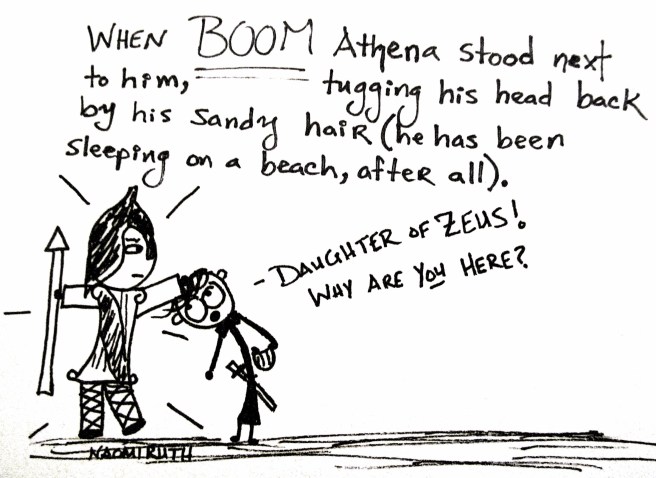
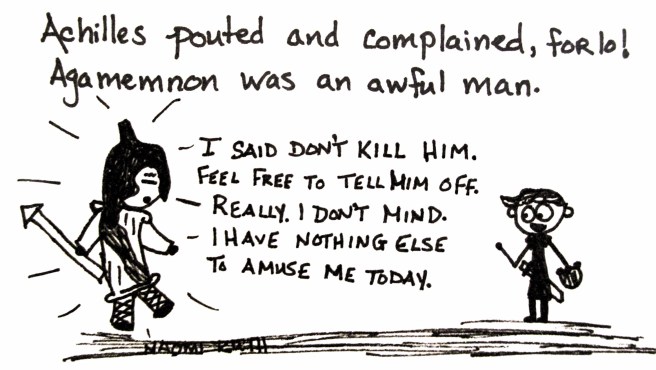
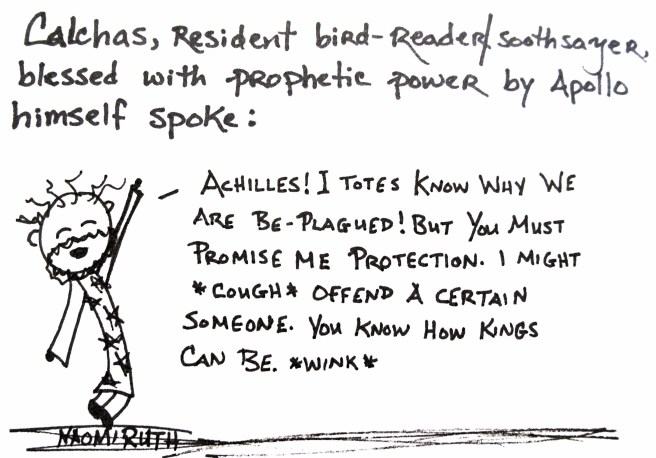
IANR.Bk1.P3.1IANR.Bk1.P3.2IANR.Bk1.P3.3IANR.Bk1.P3.4IANR.Bk1.P3.5IANR.Bk1.P3.6IANR.Bk1.P3.7IANR.Bk1.P3.8IANR.Bk1.P3.9IANR.Bk1.P3.10IANR.Bk1.P3.11IANR.Bk1.P3.12


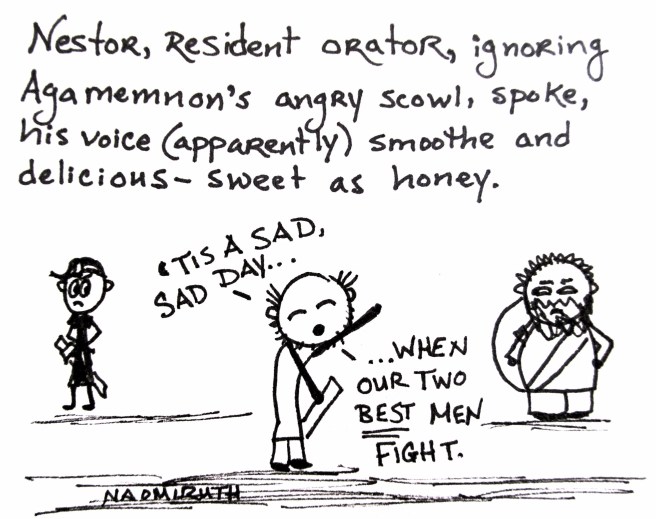
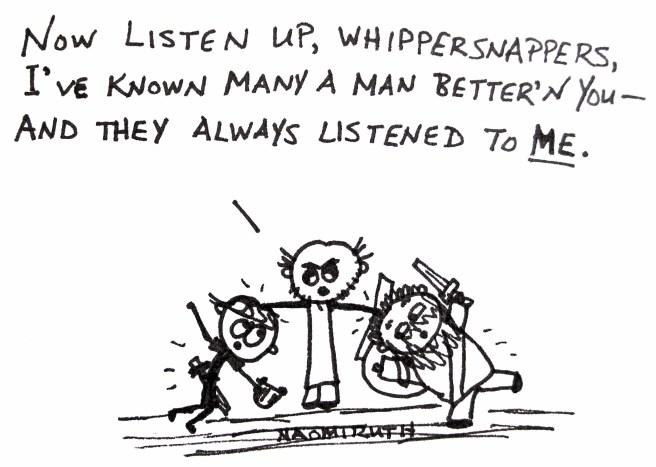
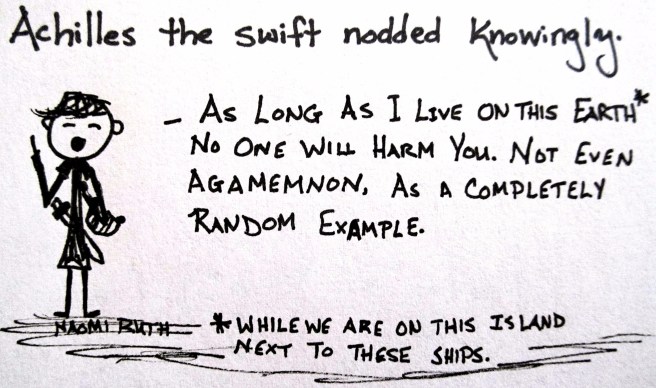
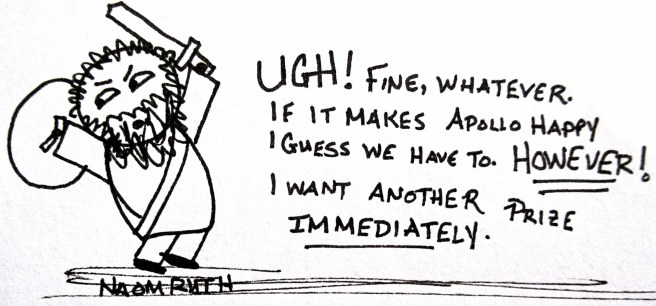
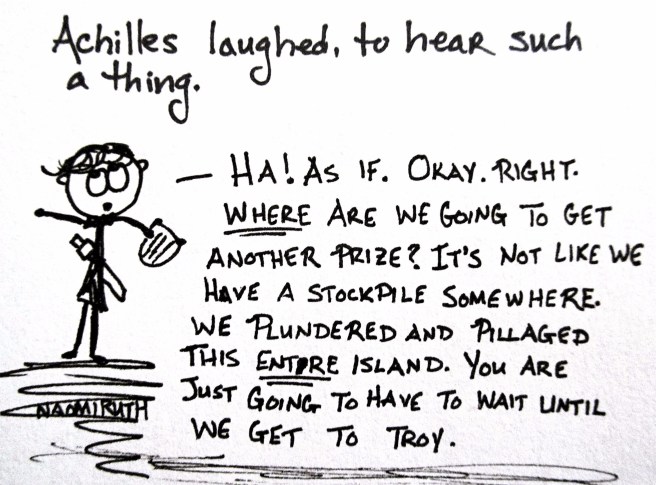
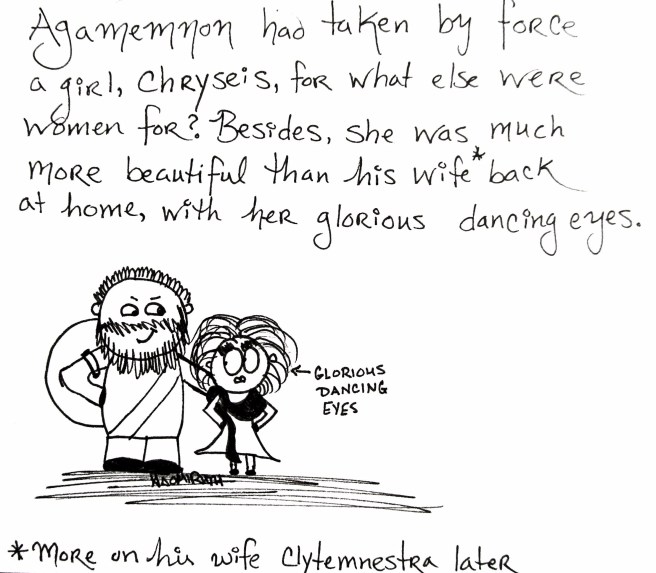
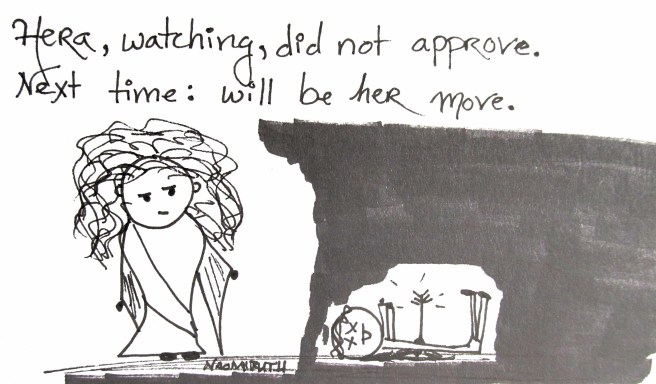
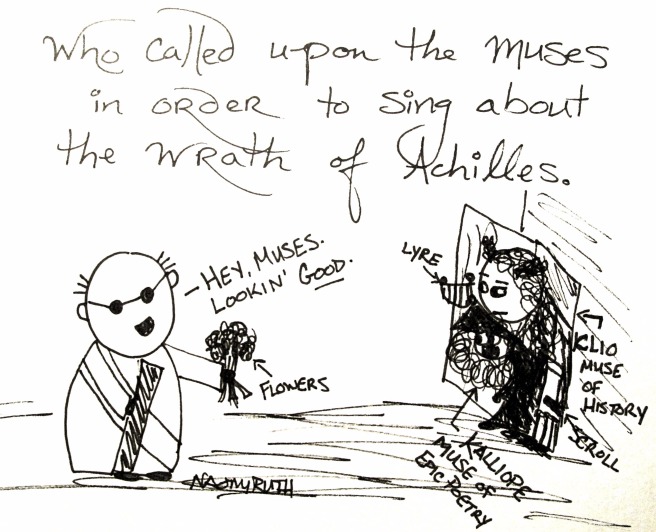
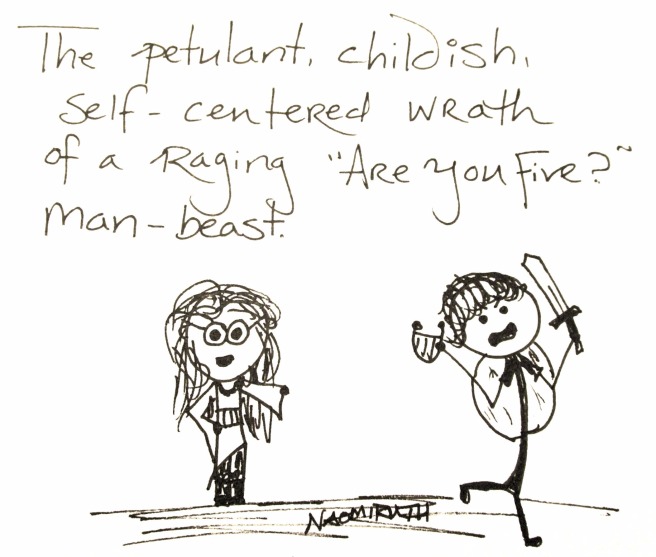
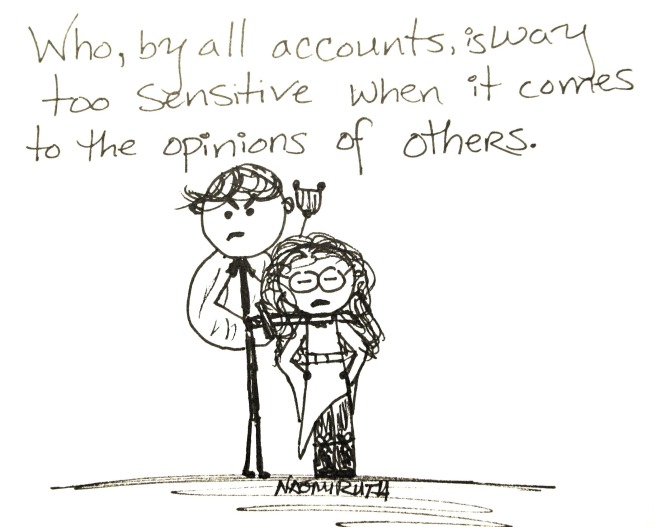
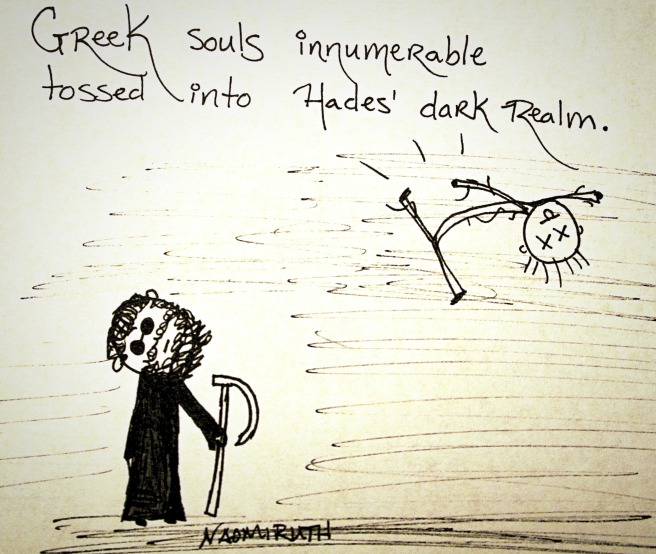
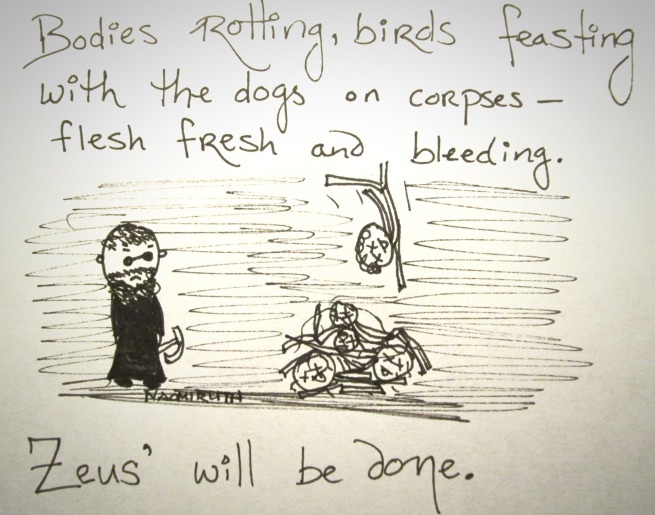
No one ever listens to the smart people in epics. NO ONE. (It’s just as bad in Song of Roland, if memory serves correctly.)

Also, poor Phoenix is having an identity crisis.

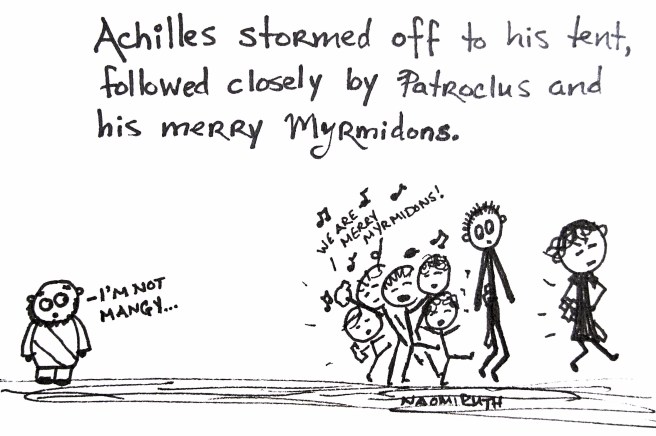
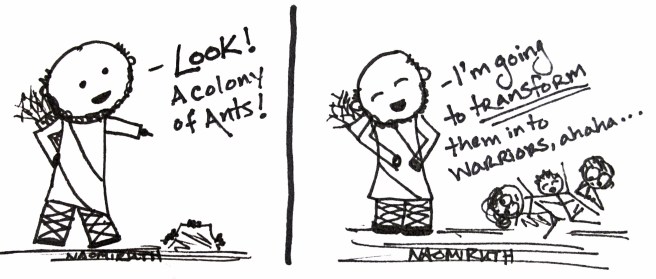
NOTE: You probably are wondering who the Myrmidons are. Or. Maybe you aren’t. BUT IF YOU ARE: The Myrmidons were a group of warriors from Thessaly, in Greece. According to legend Zeus took a colony of ants and zapped them into a group of warrior-men (myrmex is the Greek word for ant). I’m not really sure why Zeus did this, but I’m sure it amused him.

IMG_2220

Return on Wednesday for Book 1, Part 3.2: Problems of Obedience.


To Read A Problem with Obedience Click HERE.

A Note on Source Material

Before we get too much farther into this re-telling of The Iliad I would like to take a moment to talk about Sources. There are many, many, many translations of The Iliad. My understanding of ancient Greek languages is pretty basic, so I am not reading the original text. One day I will be able to do that – – but not this day. This means I have to trust a translator to help me along.

The translation I own, and which I am heavily inspired by, is Stanley Lombardo’s version. I love it. I think he does a great job of keeping a sense of humour throughout the work and it just begs to be read out loud.

I have also read most of Robert Fagles’ version, and occasionally I reference my copy from The Great Works collection (the version translated by Samuel Butler, which is not my favourite because I prefer the poetic translations, but it has its uses). If you are looking for an online version to read all you have to do is internet search it. Most likely you will find Samuel Butler’s version, but there are others.

While I do not know what translation could be considered “the best,” I will say that I enjoy the Lombardo translation, and if you do not own The Iliad yet and want to purchase a version, I highly recommend his.

Anyway! Now you know what my source material is. See you on Sunday for the next installment *mwahahahahaha*


To Read Nestor Advises to No Avail Click HERE.

Book 1, Part 2.2: Enter Athena

To Start from the Beginning Click Here
To Read the Previous Comic (to Find Out Why Achilles is Mad at Agamemnon) Click Here


IANR.2.2.1IANR.2.2.2IANR.2.2.3IANR.2.2.4IANR.2.2.5IANR.2.2.6IANR.2.2.7IANR.2.2.8IANR.2.2.9


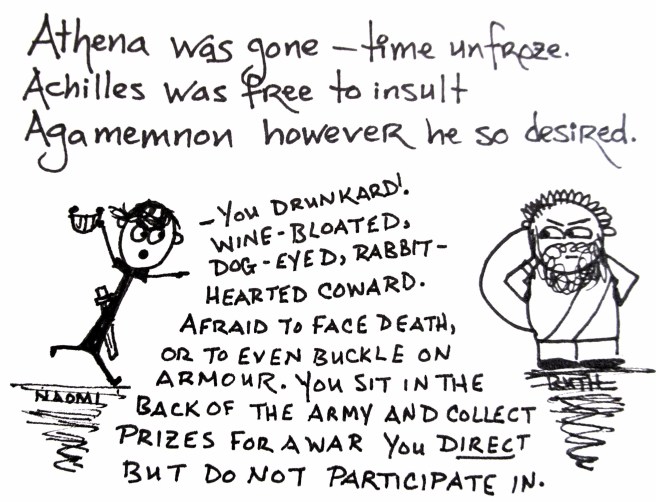
Achilles has some great insults I’ll have to keep in mind for the future…

Also, there was something else, but I don’t remember. *ponders* Oh! If you want to see what real Hellenistic bronze age helmets look like, instead of whatever it is I put on Athena’s head, see this page here or this page here.

Next Sunday will be Book 1 Part 3.1… which will probably be named the Insults of Achilles or something. I’m not sure yet, as I’m still writing the script for it. In the meantime, have a lovely day!


To Read A Note on Source Material Click HERE.
To Skip That and Read Nestor Advises to No Avail Click HERE.

Book 1, Part 2.1: The Sass of Achilles

Start at the beginning
Previous Comic


IANR.2.1.1IANR.2.1.2IANR.2.1.3IANR.2.1.4IANR.2.1.5IANR.2.1.6IANR.2.1.7IANR.2.1.8IANR.2.1.9IANR.2.1.10IANR.2.1.11IANR.2.1.12

Next Week: Book 1, Part 2.2…


It should be noted that Odysseus did NOT vote for Diomedes, he voted for himself, Indeed ALL of the Argives voted themself the Most Formidable Hero, except for Patroclus who voted for Achilles, thus winning him the vote.

ALSO: if you want to read a similar story where a king yells at a prophet see 1 Kings 22. One day I will probably stick-figure it, because it’s one of my favourite Bible stories.

ALSO: Do not be surprised if the next time Calchas shows up he’s drinking a Pumpkin Spice Latte.


To Read Enter Athena Click HERE.

Book 1, Part 1.1: Prologue

Welcome to Book 1, Part 1 of Part 1! [I had to divide things up more than I thought I would so… It’s weird. Sorry.]


IMG_2122IMG_2123IMG_2125IMG_2126IMG_2127IMG_2128IMG_2129IMG_2130IMG_2131


I shall return on Wednesday with the next installment! It will be called: A Plague on All Your Houses! Or, something like that. I figured it out, and based on the progress I have made so far, averaging it all out, I should be done re-telling the Iliad in three years. Haha… We have a long way to go. I’m excited. *swoons*


P.S. I TOLD YOU I WOULD GET HADES IN HERE SOMEHOW, Mwahahahahahaha…


To Read A Plague Be Upon You Click HERE.

Potentials for Miscommunication & Problems of Author Bias

Last time we talked about Homer and whether or not he really existed. HOWEVER, whether or he was real or merely a legend, we are left with the same problem when viewing the text. In fact, everything in this post will be applicable for pretty much any of the Greek or Roman texts that I will reference in the future, so this post is not only relevant for The Iliad, but for other ancient texts as well.

These texts have a very different bias than we do (or, at least, it most likely does, unless you are a rare and mysterious individual) and therefore there are some major Potentials For Miscommunication. Some of these PFM’s are listed below:

  1. Time. These epics were created and written down many, many years before I was born, and therefore, many, many year before you were born (unless you are a time-traveling doctor or a girl named Julianna, who is secretly thousands of years old). The way people lived back then was very different from how we live now (especially to us living in the modern Western world). Even how we view the concept of time may be different. Consider, for example, the Mesoamericans and their quadripartite concept of time — very few people will even know what that means, but for a pre-conquest Mesoamerican it was just a part of life. So too might the Greeks or Romans view time conceptually different than however you do.
  2. Place. None of us are living in Ancient Greece or on the Ionian Coast. Most of you are not even living in Greece or Turkey. (If you are: while this PFM is not as terrible for you, the landscape has still changed quite a bit since the Stone/Bronze/Iron Age.) The Mediterranean world is different geographically from, say, the Hudson or Wyoming Valleys. Therefore, the land you are looking at and living in is not the same land Agamemnon would have looked at or lived in. [A person’s Sense of Place and the Significance of Place is something I will probably go into more detail later.]
  3. Language. These were written in an old form of Greek (or Latin) that no one actively speaks anymore. You will most likely be reading a translated text. Every time you translate something, you re-make it. Every translator is going to bring their own views and vocabulary to the text. It’s impossible not to. So even if you are reading the original text it is still a translation, because YOU are translating it. You are not an ancient Greek, and therefore no matter what you do you will have to translate this text and in the translating of it, re-make it.
  4. Poetic Language. Not only is The Iliad written in old time Greek , but the text uses poetic devices all over the place. It uses a whole lot of symbolism, metaphor, epic simile, and more. It talks about pastoral images a lot (like leaves and fields and leopards), which seems really weird when you read it the first time. The poem has a specific rhythm and meter and all that (which I will NOT explain because poetic forms is not my forte). It repeats a lot of phrases, because this is what poets used to help them remember what came next in the poem. That’s why Athena is often spoken of as “grey-eyed” and the sea is “wine-dark.” These phrases not only fit the meter of the poem, BUT also helped the poet remember where he was in the poem when he was dramatically reciting to the masses.
  5. Repetition. Because Homer’s poems were recited out loud to crowds there is a WHOLE lot of repetition, just in case someone wanders around the campfire/into the crowd and doesn’t know what happened yet; or in case someone dozed off; or in case some poor child was fighting desperately to focus but, really?, couldn’t. Also, #becausepoetry. (That is the only explanation you’re going to get out of me, because I am that bad at poetic vocabulary/definitions.)
  6. Values, Ethics, and Moral Ideals. Some of the ancient Greek/Roman values and ethics will overlap with our modern ones; some of them definitely won’t. Don’t be quick to judge, but try to think of the world through their eyes. They don’t have phones or fancy magic devices, they barely have swords. They don’t have burger fast food places, they have fields of barley and a whole lot of drought. No cars, but difficult seas that sometimes stranded you for three months because of the currents and the weather. Their world is going to be different than ours, so their values are going to reflect that. Also, they live in a different time period, in a different land, with a different religious outlook (unless you are a Hellenic Reconstructionist of some sort, in which case, the differences religiously won’t be as bad). Even if they didn’t live in such a different time/place, remember: your values, ethics, and moral ideals could be different from your next-door neighbors values, ethics, and moral ideals, so it’s important to be able to understand and be aware of this PFM in particular, because it is something that will show up in your day to day life.

Some other points to remember when considering authorship, particularly with ancient Greek or Roman works, is that the person who created/wrote it was:

  1. Male. (Unless possibly Sappho). It is sad, but true. Until you get to Anna of Byzantium, outside of some poetry, it’s all males all the time, and that bias shows, sometimes like #WHAT.
  2. Educated. You don’t write things down if you aren’t educated. Mostly because you can’t write things down if you don’t know how words or alphabets work. #thisshouldbeobvious
  3. Probably middle/upper class. You don’t get educated if you don’t have monies.
  4. Sexist. Women are poetic devices at best. Some authors are less sexist than others, but yeah. The Greek and Roman world is INCREDIBLY male-centric/phallo-centric, whatever fancy term you want to use to describe it. Sometimes this is painful. I try to be fair, because that is the world they grew up in, but sometimes my own bias will come out in a roar, so be prepared for that.
  5. Polytheist. Whether hardcore, fairly agnostic, meh, or more atheistic, the polytheist view is going to color EVERYTHING in the Greek/Roman world. If you are used to a monotheistic viewpoint, I promise you, some things in these texts just won’t jive and will leave you flummoxed. Do your best.
  6. Ethnicity/Race. Greeks are VERY pro-Greek everyone else is stupid/barbaric/uncivilized/a cannibal. Romans are VERY pro-Roman everyone else is stupid/barbaric/uncivilized/not as good as us. The Greek worldview is very anti-anyone else (part of their hatred of Thrace). The Romans are very We Are The Most Awesome HAHAHAHA, which is why they downplay the importance of Etruria like #WHAT. So whenever a Greek/Roman author is talking about someone/a group that isn’t part of their group, BE AWARE, a bias is happening.

There are other lenses that authors look through that create their bias, of course. These are just some basic things to keep in mind. A future post delving into ancient Greek ethics/values may happen one day, and at that time will be linked to HERE. But not this day.


ALSO: Obviously, I am an author so I have a bias. All of these categories also relate to what I’m writing. While I do try my best to be accurate and fair, sometimes I, like Herodotus, exaggerate/gossip/re-invent because it makes a story, quite simply, better. Keep this in mind and forgive me my re-interpretations of text, as I forgive those who re-interpreted before me.


To Begin By Reading The Prologue Click HERE.

Who the Heck is Homer?

He was a man who may or may not have existed.

The story: he was a blind poet who was freaking awesome and created both The Illiad and The Odyssey and one day some sycophant wrote it all down for him.

The more probable truth: The Illiad and The Odyssey were oral tales told by wandering poets for generations and one day someone or someones decided to write them down for posterity.

Why is this more likely? Two reasons!

  1. Because both of Homer’s epic poems mix references to both The Stone Age and The Bronze Age. They cannot decide where in time they actually are.
  1. This is what happened with the Finnish Kalevala, giving us a historical precedent and all that. The Kalevala was an oral tradition and was later written down by Elias Lönnrot.

Maybe Homer was the Elias Lönnrot of the ancient Greek world, maybe not. HOWEVER: a random blind poet living in a cave is way more amusing, so we’re just going to pretend like he exists.


*EXTRA CREDIT*

Question: Why was Homer a blind poet?

Answer: There are a collection of poems called The Homeric Hymns which were not all written by Homer (and maybe none of them were) but for quite some time people thought they WERE all written by Homer. In one of the poems, “Hymn 3 To Apollon” lines 171-173 to be exact, it says:

“Do tell him in unison that I am he,/a blind man, dwelling on the rocky island of Chios,/whose songs shall all be the best in time to come.”

[I am quoting Apostolos N. Athanassakis’s version, which is the one I own and highly recommend.]

This made people think that Homer is telling his audience that he is this blind man living on an island, which means it must be true, obvs.

*END OF EXTRA CREDIT*


There you have it! Now you know who the heck Homer is. Or. Um. Who he allegedly is. We still don’t know if he… actually… was. AHEM. Next time we will talk about The Problems of Author Bias.

IN THE MEANTIME: Here is a link to a picture of an idealized bust of Homer — which is hilarious to me, but probably isn’t supposed to be.

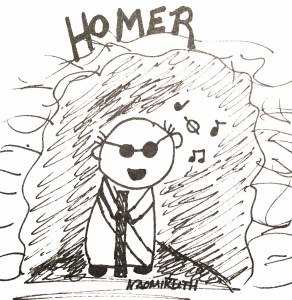
PLUS: My version of Homer…
IANRHomer

Just chillin’ in his cave, singing about destruction and xenia.*


*Xenia: a Greek concept we’ll learn about more in the future.*

ALSO To Learn About Potentials for Miscommunication and Problems of Author Bias Click HERE.

Who You Need to Know Part III: The Immortals

*If you missed it:
Who You Need to Know Part I: Argives
Who You Need to Know Part II: Trojans*


…also known as Gods and Goddesses and a Random Sea-Nymph. If you don’t know anything about Greek mythology/traditional religion that sucks. I’m only going to give you the basics. Also, where have you been? *shakes head in disapproval*
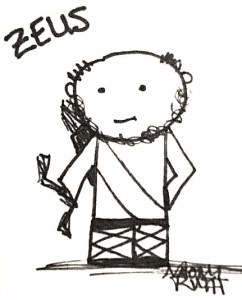

IANR.Im.ZeusZeus, king of the gods, husband of Hera, brother to Poseidon and Hades, lover of many, more concerned with people learning lessons than taking sides, although people consider him on the Trojan side, because Thetis.

IANR.Im.HeraHera, queen of the gods, Zeus’ wife, allied with Athena, on the side of the Argives.
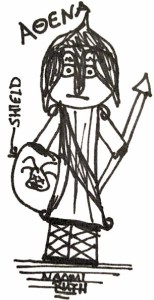
IANR.Im.AthenaAthena, daughter of Zeus (popped out of his head one day), allied with Hera, on the side of the Argives, all about war and wisdom.
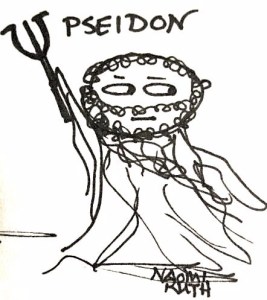
IANR.Im.PseidonPoseidon, brother of Zeus and Hades, helped the Trojans build their city but they never re-paid him, therefore, on the side of the Argives. Also, Argives are big ship people and, therefore, give him proper sacrifice and attention, since he’s in charge of the sea and earthquakes and such.
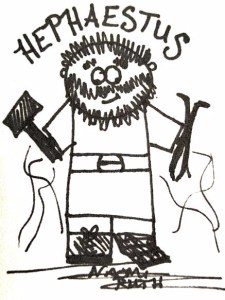
IANR.Im.HephaestusHephaestus, husband to Aphrodite, lame, god of metalsmithing, makes Achilles armour and rescues him from Scamander, so kind of on the Argives’ side?
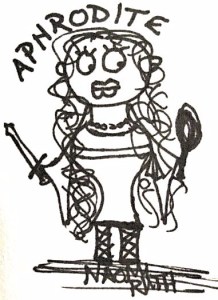
IANR.Im.AphroditeAphrodite, daughter of Zeus, mother of Aeneas so, therefore, on the side of the Trojans. She’s all about love and war and comes off much more a wimp than she actually is.

IANR.Im.ApolloApollo, son of Zeus, twin brother to Artemis, gods of music and the sun, on the side of the Trojans.

IANR.Im.ArtemisArtemis, daughter of Zeus, twin sister to Apollo, goddess of the hunt and people like slaves and outcasts, on the Trojan side, just like her brother.

Ares, god of war, just war, no brains, lover of Aphrodite, supports Trojans mainly, but really as long as people are fighting he’s happy.
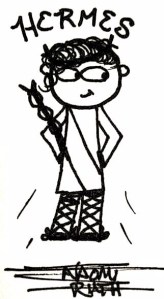
IANR.Im.HermesHermes, messenger of the gods, kind of hilarious, I love him. Sort of on the Argives side, but helps the Trojans as well.
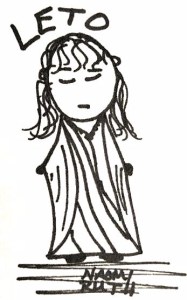
IANR.Im.LetoLeto, daughter of Titans, mother of Apollo and Artemis, sort of on the Trojan side.

IANR.Im.ThetisThetis, sea-nymph, mother of Achilles, calls in a favour from Zeus to try and convince him to side with the Argives. Not sure this really did her son any good, tbh.


There are your Immortals! Next time we will finish everything up with our handful of characters who aren’t on one side or the other of the war.

To Meet The Rest Click HERE.

Whoops

SO, apparently, I have been writing Iliad wrong this WHOLE TIME. And I’m not just talking about my last few posts here. I mean on my tests, paper topics, review sheets, whiteboard notes during the entire quarter I taught this book — and none of my students noticed. My professor from college (who is fabulous, by the way) was kind enough to point this out. I could swoon from embarrassment. HOWEVER, I do have this occasional problem with doubling consonants. I once wrote Agamemnon as Aggammemmnnon and stared at it, knowing something truly wrong had happened, but wasn’t sure how to go about fixing it. SO, I have gone back and fixed all of my references to the Iliad on here (although, not on instagram so… oh well).
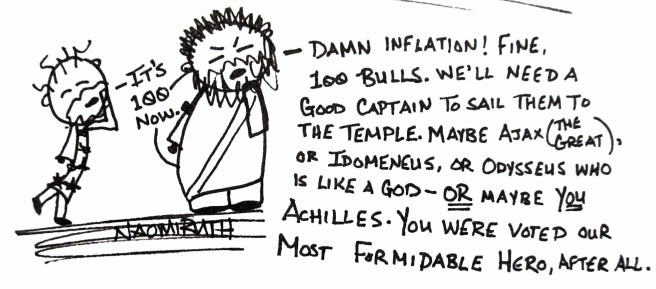
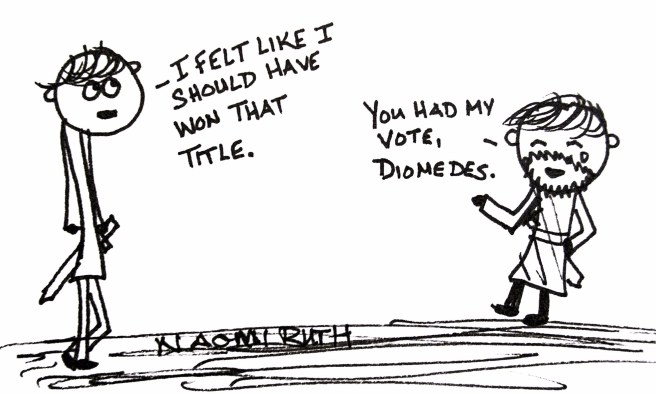
Why am I telling you this? Because mistakes happen sometimes. I spend a great deal of time with ancient history, but I am still going to make some silly mistakes occasionally. There is a good possibility that one day you will make a silly mistake. When you do, you can remember that you are not alone and that it is (most likely) not the end of the world.

Have a good day, my lovelies!